WHITE PAPER: Why Sexual Abuse and Molestation Coverage Has Become So Difficult to Place
ARTICLE August 2026
Sexual abuse and molestation coverage, often referred to as SAM coverage or abuse liability coverage, has become one of the most challenging liability coverages to place in today’s insurance marketplace.
Just a few years ago, many organizations could secure abuse coverage with relatively limited underwriting scrutiny and broad market participation. That is no longer the case. Carriers have reduced capacity, underwriting requirements have become significantly more detailed and available coverage often comes with higher retentions, lower limits and more restrictive policy language.
While schools, churches, and youth-serving organizations have long been associated with abuse exposures, the current market extends far beyond those classes. Healthcare providers, human services organizations, senior living communities, behavioral health facilities, and residential programs are experiencing many of the same underwriting challenges.
Why Carriers Are Pulling Back
The primary driver behind today’s abuse liability market is uncertainty.
Many states have expanded statutes of limitation for sexual abuse claims, implemented revival windows or adopted laws that allow allegations involving conduct from decades ago to move forward. As a result, insurers face the possibility that exposures they once considered closed may re-emerge years later.
At the same time, abuse allegations are increasingly being framed as institutional failure cases rather than isolated acts committed by one individual. Plaintiffs frequently allege:
- Negligent hiring
- Negligent supervision
- Failure to train
- Failure to report
- Failure to protect
- Inadequate policies and procedures
These allegations can significantly increase claim severity and make losses more difficult for carriers to predict.
The Impact of Nuclear Verdicts and Mass Litigation
Another factor reshaping the market is the growing size of abuse-related verdicts and settlements. While the industry often defines a nuclear verdict as one exceeding $10 million, recent abuse cases have produced settlements measured in the hundreds of millions and, in some cases, billions of dollars.
Large-scale litigation involving public entities, religious institutions, and youth organizations has demonstrated how abuse claims can create losses that span decades, trigger multiple policy years and involve numerous insurers and reinsurers.
Several high-profile examples continue to influence carrier appetite today:
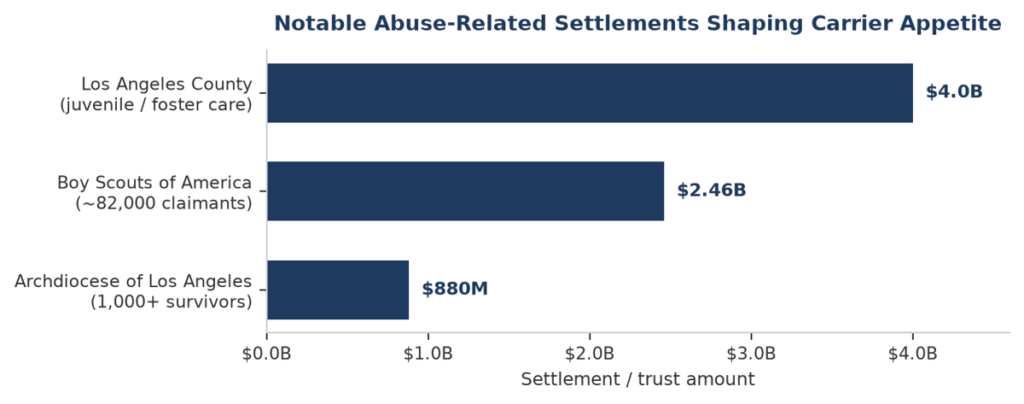
Los Angeles County’s $4 billion settlement (thousands of juvenile detention and foster care claims); the Boy Scouts of America’s ~$2.46 billion bankruptcy settlement trust for more than 82,000 claimants; and the Archdiocese of Los Angeles’ $880 million settlement involving more than 1,000 abuse survivors.
For insurers, these cases highlight the long-tail nature of abuse liability and the potential for catastrophic severity.
Abuse Exposure Goes Beyond Sexual Misconduct
One of the most important conversations agents should have with clients is whether their coverage addresses only sexual abuse or also responds to allegations of physical abuse, neglect and failure to protect.
Many insureds assume these exposures are addressed together. In reality, coverage can vary significantly from one carrier to another. A lawsuit may include allegations involving:
- Sexual abuse
- Physical abuse
- Emotional abuse
- Negligent supervision
- Improper restraint
- Failure to report
- Failure to protect
- Neglect
Because multiple theories of liability are often alleged within the same claim, the actual policy wording matters far more than simply confirming that an abuse endorsement exists.
This issue is particularly important in healthcare, human services, and senior living settings where allegations may involve resident-on-resident incidents, improper restraints, neglect, exploitation, or inadequate supervision rather than sexual misconduct.
Healthcare and Social Service Organizations Face Unique Challenges
For senior living and healthcare organizations, abuse-related claims are often tied to operational failures rather than intentional misconduct. Claims may arise from allegations involving:
- Resident-on-resident violence
- Improper restraint
- Inadequate supervision
- Failure to monitor vulnerable individuals
- Neglect
- Failure to respond to known behavioral concerns
A serious injury involving a memory care resident, for example, may ultimately be litigated as a failure-to-protect claim. Likewise, allegations involving staffing shortages, poor training, or inadequate documentation can quickly evolve into broader institutional negligence allegations.
These exposures have become a growing area of concern for underwriters evaluating healthcare and human services accounts.
The Challenge of Exposures Organizations Cannot Fully Control
One reason abuse liability remains difficult for insurers to underwrite is that many claims involve individuals who are not traditional employees or situations that occur outside direct supervision.
Organizations may implement robust screening, training, and reporting procedures, but exposures can still arise from third parties, volunteers, independent contractors, visitors, family members, residents, clients, or participants interacting with one another. In many cases, the organization is not accused of committing the wrongful act itself.
Instead, the allegation centers on whether the organization should have prevented, detected, or responded to the incident. For example, claims may involve:
- Volunteer misconduct
- Independent contractors or third-party service providers
- Client-on-client incidents
- Resident-on-resident incidents
- Student-on-student misconduct
- Visitor interactions with vulnerable individuals
- Transportation activities
- Off-site events or community activities
From an underwriting perspective, these exposures are difficult because they are less predictable than traditional employee-related risks. Plaintiffs’ attorneys frequently focus on questions of supervision, monitoring, reporting, and institutional oversight. Even when an organization had no direct involvement in the alleged misconduct, carriers may still face allegations that the organization failed to protect vulnerable individuals from foreseeable harm.
As a result, underwriters often place significant emphasis on supervision procedures, volunteer management, contractor screening requirements, incident response protocols, and documentation practices when evaluating abuse-exposed risks.
Coverage Terms Are Becoming More Restrictive
Even when abuse coverage is available, coverage structures often look very different than they did several years ago. Common marketplace changes include:
- Lower available limits
- Higher deductibles and self-insured retentions
- Separate abuse aggregates
- Defense costs within limits
- Claims-made coverage structures
- More restrictive definitions of abuse
- Increased use of abuse-specific exclusions
- Expanded supplemental applications and underwriting questionnaires
Carriers are also requesting significantly more information regarding screening procedures, background checks, training protocols, reporting requirements, and supervision standards.
What Underwriters Want to See
Organizations that achieve better underwriting results typically demonstrate strong risk management practices. Underwriters often focus on whether the organization maintains:
- Written abuse prevention policies
- Criminal background screening
- Employee and volunteer vetting procedures
- Formal training programs
- Mandatory reporting protocols
- Incident documentation procedures
- Clear investigation and corrective action processes
- Ongoing executive or board oversight
A well-documented risk management program does not eliminate exposure, but it can improve an organization’s attractiveness to underwriters.
Why Agents Need to Start the Conversation Early
Abuse liability coverage has become both more difficult and much more expensive to procure. Even well-run organizations with strong risk management controls may face premium increases, higher retentions or reduced limits as carriers continue to reassess the exposure. Starting the renewal process early gives agents time to manage expectations, gather underwriting information, and explore alternatives if the incumbent carrier changes its appetite or terms.
Once terms are received, agents should review whether coverage:
- Is included, excluded, or sublimited
- Applies to both sexual and physical abuse allegations
- Includes defense costs inside or outside the limit
- Is written on an occurrence or claims-made basis
- Provides prior acts coverage
- Includes a separate abuse aggregate
- Addresses neglect, corporal punishment, and improper restraint allegations
- Extends through umbrella or excess policies
Final Thoughts
The abuse liability marketplace has changed dramatically over the last several years. Social inflation, evolving statutes of limitation, large-scale settlements, and increasing allegations of institutional negligence have caused carriers to reassess both appetite and capacity.
Just as important, abuse exposure is no longer viewed solely through the lens of sexual misconduct. Physical abuse, neglect, improper restraint, failure-to-protect allegations, and broader institutional liability concerns are now a central part of the underwriting discussion.
For independent agents, the focus should be on understanding policy language, managing client expectations, and beginning renewal conversations early. Organizations that invest in prevention, training, and accountability will generally be better positioned in a difficult marketplace.
Equally important, working with a specialist wholesale broker can help agents navigate complex forms, identify coverage gaps, and locate markets willing to consider abuse-exposed classes.
In today’s environment, securing abuse coverage is only part of the challenge. Understanding how that coverage will respond when a claim occurs is what matters most.